Transforming in-store shopping for blind and low-vision customers through smart lens technology with integrated radar and AI vision
Project Overview
2.2 million people in the UK are living with sight loss. For blind and low-vision individuals, shopping in convenience stores, supermarkets, and off-licenses remains a frustrating, often impossible, independent activity. Current solutions—asking staff, memorizing layouts, or relying on sighted companions—strip away dignity and independence.
The Problem: Existing stores are designed for sighted customers. Product locations change, aisles are crowded, signage is visual-only, and checkout queues are chaotic. No current technology provides real-time spatial guidance, obstacle detection, and item identification that truly empowers independent shopping.
Design a revolutionary smart lens device: lightweight glasses with integrated camera, radar sensors, and bone conduction audio providing real-time navigation, obstacle detection, and voice-guided product identification—completely hands-free.
Led user research with blind/low-vision shoppers, designed complete user experience from store entrance to checkout, and validated solution through usability testing.
Enable independent shopping for 2.2M UK sight loss community. Transform retail accessibility. Create replicable model for Tesco, Asda, Sainsbury's, Co-op, and independent stores.
Research & Discovery
I conducted extensive research with the blind and low-vision community to understand their shopping experiences, pain points, and needs.
I evaluated current assistive shopping technologies:
Gap Identified: No solution combines real-time spatial awareness, obstacle detection, turn-by-turn navigation, and product identification in one integrated experience.
User Personas
Based on research with 20 blind and low-vision shoppers, I created three primary personas representing the diversity of our user base.
Age 42, Blind from birth
Nottingham, UK
David is a software developer who uses JAWS screen reader at work and VoiceOver on his iPhone. He uses a white cane for mobility and is highly tech-savvy. Lives independently and values autonomy.
iPhone with VoiceOver, white cane, Be My Eyes app (but doesn't always work well in stores), Seeing AI for occasional label reading
Age 67, Low vision (macular degeneration)
Derby, UK
Eleanor is a retired teacher whose vision has deteriorated significantly over the past 5 years. She has peripheral vision but no central vision—can't read text or recognize faces. Uses screen magnification on her tablet.
Previously used smartphone with screen magnification, prefers audio feedback, less tech-confident than younger users but excited about hands-free solutions
User Journey Mapping
Following David through a typical shopping trip to Tesco Metro to buy groceries for dinner.
Makes mental list of items needed. Calls store to ask if they have specific items in stock. Plans route memorizing last visit's layout 3 weeks ago.
Time: 20 minutes
Arrives at store. Automatic doors open. Uses white cane to feel for shopping baskets. Can't find them—location changed. Staff member notices and brings basket.
Barrier: No audio cue for basket location. Requires help immediately.
Heads toward dairy section based on memory. Store has rearranged aisles since last visit. Walks down wrong aisle. White cane hits promotional display—items fall.
Barrier: No way to know layout changed. No obstacle warning. Feels embarrassed.
Time wasted: 8 minutes
Asks staff member where milk is. Staff walks him to dairy section. Reaches milk shelves. Can't tell which is whole milk vs. semi-skimmed vs. plant-based. Tries Be My Eyes app on phone. Waits 4 minutes for volunteer. Poor lighting makes camera focus difficult.
Barrier: No independent way to identify products. Relies on strangers' availability.
Time: 12 minutes for one item
Needs bread and pasta sauce. Each item requires repeating the process—finding aisle, identifying product, checking price. Gives up on pasta sauce after 10 minutes. Settles for whatever staff member hands him.
Result: Can't shop for what he actually wants. Compromises constantly.
Heads to checkout area. Multiple queues but can't tell which is shortest or if any registers are open. Hears beeping—assumes self-service. Self-service machines have visual touchscreens—completely inaccessible. Joins staffed till queue. Can't tell when it's his turn—waits for staff to call him.
Barrier: No audio queue management. Self-service inaccessible.
Finally checks out after 45 minutes for 3 items. Didn't get everything he wanted. Had to ask for help 6 times. Feels like a burden. Vows to stick to online delivery despite preferring fresh food shopping.
Total time: 1 hour 5 minutes (should take 15 minutes)
Success rate: Got 2 of 5 items he wanted
Independence: Required 6 interventions from staff/volunteers
The Solution
ShopAssist is a revolutionary smart lens device—lightweight glasses integrating HD camera, millimeter-wave radar, and bone conduction speakers—that provides completely hands-free navigation, obstacle detection, and product identification for truly independent shopping.
Follow David's shopping journey with ShopAssist in this visual guide.
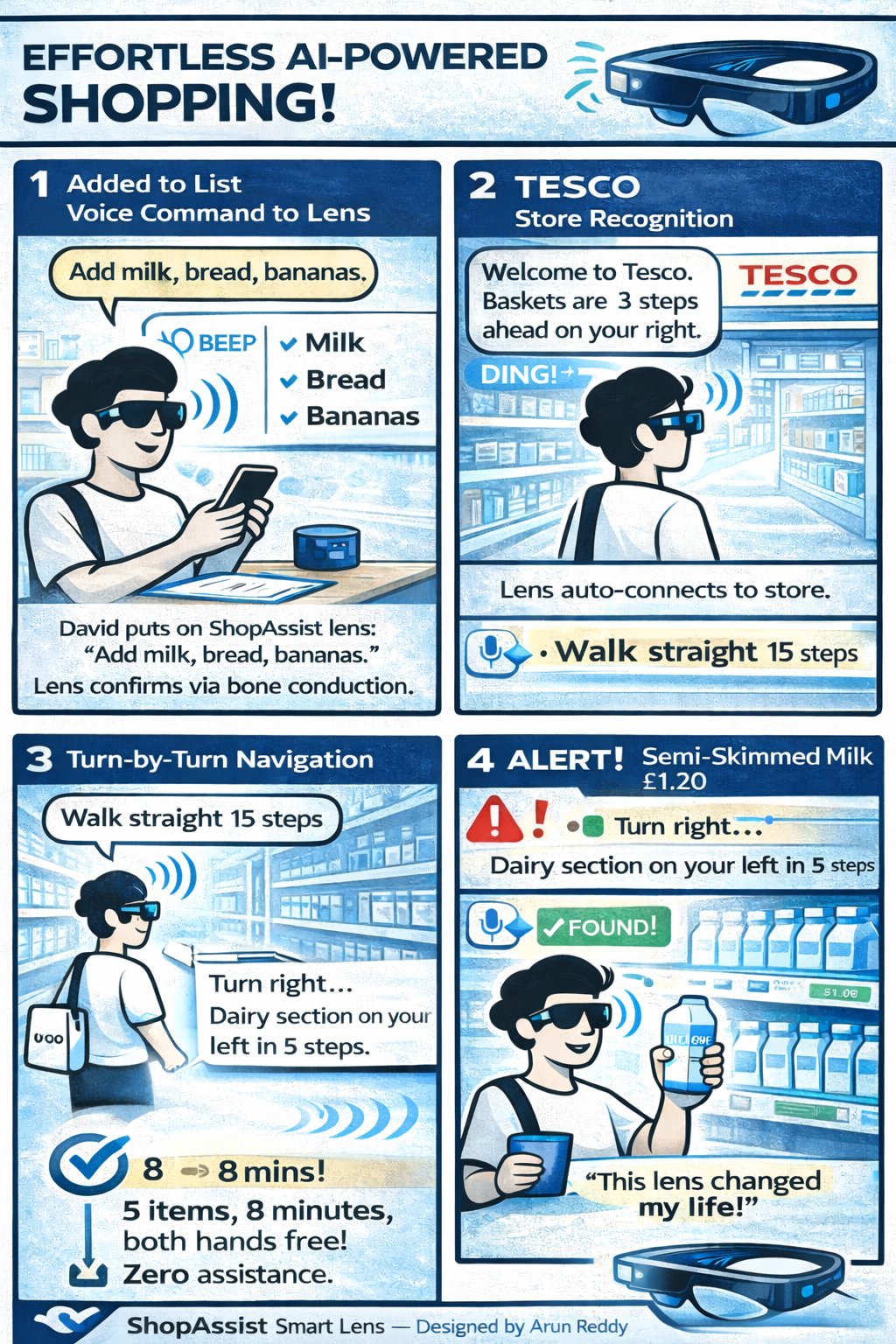
How it works: The lens uses store map data + Bluetooth beacons + onboard sensors to provide precise indoor navigation through bone conduction audio—completely hands-free.
Voice guidance examples:
User benefit: Navigate unfamiliar stores confidently without memorization or assistance.
How it works: Integrated millimeter-wave radar + HD camera with AI vision analyzes environment 60 times per second, detecting obstacles even in low light or peripheral vision.
Detects and alerts for:
User benefit: Shop safely without collisions or falls.
How it works: Simply look at the shelf. The lens camera automatically identifies products in your field of view and announces details through bone conduction.
Information provided:
User benefit: Choose exactly what you want, compare prices, check expiry dates independently.
How it works: Pick up a product and look at it. The lens automatically detects and scans barcodes, reading full product information aloud.
Provides full details:
User benefit: Make informed purchasing decisions, check for allergens, avoid expired products.
How it works: Create your list via voice command at home. The lens guides you to each item in optimal route—completely hands-free navigation.
Features:
User benefit: Efficient shopping, never forget items, guided to everything you need.
How it works: Lens identifies checkout area, counts people in queues, and guides you to the shortest line with real-time position updates.
Guidance provided:
User benefit: Find checkout quickly, know when it's your turn, choose accessible options.
Future State Journey
The same shopping trip transformed through accessible technology. David uses ShopAssist for the first time at Tesco Metro.
David puts on his ShopAssist lens. Voice command: "Create new shopping list." David: "Add semi-skimmed milk, wholemeal bread, pasta, tomato sauce, and bananas." Lens: "5 items added. Select your store." David: "Tesco Metro, High Street." Lens: "Route prepared. Ready to shop."
Time: 2 minutes
Arrives at store wearing his ShopAssist lens. Automatic doors open. Lens: "Welcome to Tesco Metro. Shopping baskets are 3 steps ahead on your right." David walks forward, finds basket immediately. Lens: "Basket located. Ready to shop. First item: semi-skimmed milk. Navigate to dairy section?"
Barrier removed: Instant orientation. No assistance needed.
Lens: "Walk straight 15 steps." David walks hands-free. Lens: "Turn right at aisle end." David turns. Radar detects obstacle: "Cart 3 meters ahead, move slightly left." David adjusts path. Lens: "Dairy section on your left in 5 steps... You've arrived. Milk shelf directly in front."
Breakthrough: Safe navigation with obstacle avoidance. No wandering, no collisions.
Time: 45 seconds
David simply looks at the milk shelf. Lens camera auto-scans: "Detecting products... Found: Tesco Whole Milk £1.25, Tesco Semi-Skimmed £1.20, Tesco Skimmed £1.15, Oat Milk £1.80." David: "Select semi-skimmed." Lens: "Semi-skimmed milk is second from left. Best before 20th January." David picks up correct bottle first try—both hands free.
Breakthrough: Independent product selection. No waiting for Be My Eyes. Exact item he wanted.
Time: 20 seconds
Lens guides David to bread aisle (30 seconds), identifies wholemeal bread (15 seconds), navigates to pasta section (25 seconds), finds preferred pasta sauce (20 seconds), locates fresh bananas (30 seconds). Each product identified by simply looking at shelves. Both hands free for carrying items. No backtracking. No help needed.
Result: Got every item he wanted, exactly the brands he prefers.
Time: 3 minutes total for all items
Lens: "Shopping complete. Navigate to checkout?" David: "Yes." Lens: "Checkout area ahead. 3 tills open. Shortest queue: till 2, straight ahead 10 steps. 1 person ahead of you." David joins queue. Lens detects movement: "Next customer. Move forward to till." David steps up immediately, completes transaction—hands free throughout.
Breakthrough: Chose optimal queue. Knew exactly when to move forward. No confusion.
David exits store with all 5 items he wanted in under 10 minutes. Didn't ask anyone for help. Feels capable and normal. Plans to try larger Tesco next week. Sends feedback: "This is life-changing. For the first time, I feel like a regular customer."
Total time: 8 minutes (vs 1 hour 5 minutes before)
Success rate: 5 of 5 items (vs 2 of 5 before)
Independence: 0 assistance requests (vs 6 before)
Design & Technical Specifications
Impact & Benefits
Shop without relying on sighted companions, staff assistance, or volunteers. Complete autonomy from store entrance to checkout.
Reduce shopping time by 88% (from 65 minutes to 8 minutes). No more wandering aisles or waiting for assistance.
Navigate stores safely with obstacle detection. No collisions, falls, or accidents. Shop with confidence in any store.
Choose exactly what you want, not what staff hand you. Compare prices, check dates, read labels independently. Shop like everyone else.
Implementation Roadmap
Future Vision
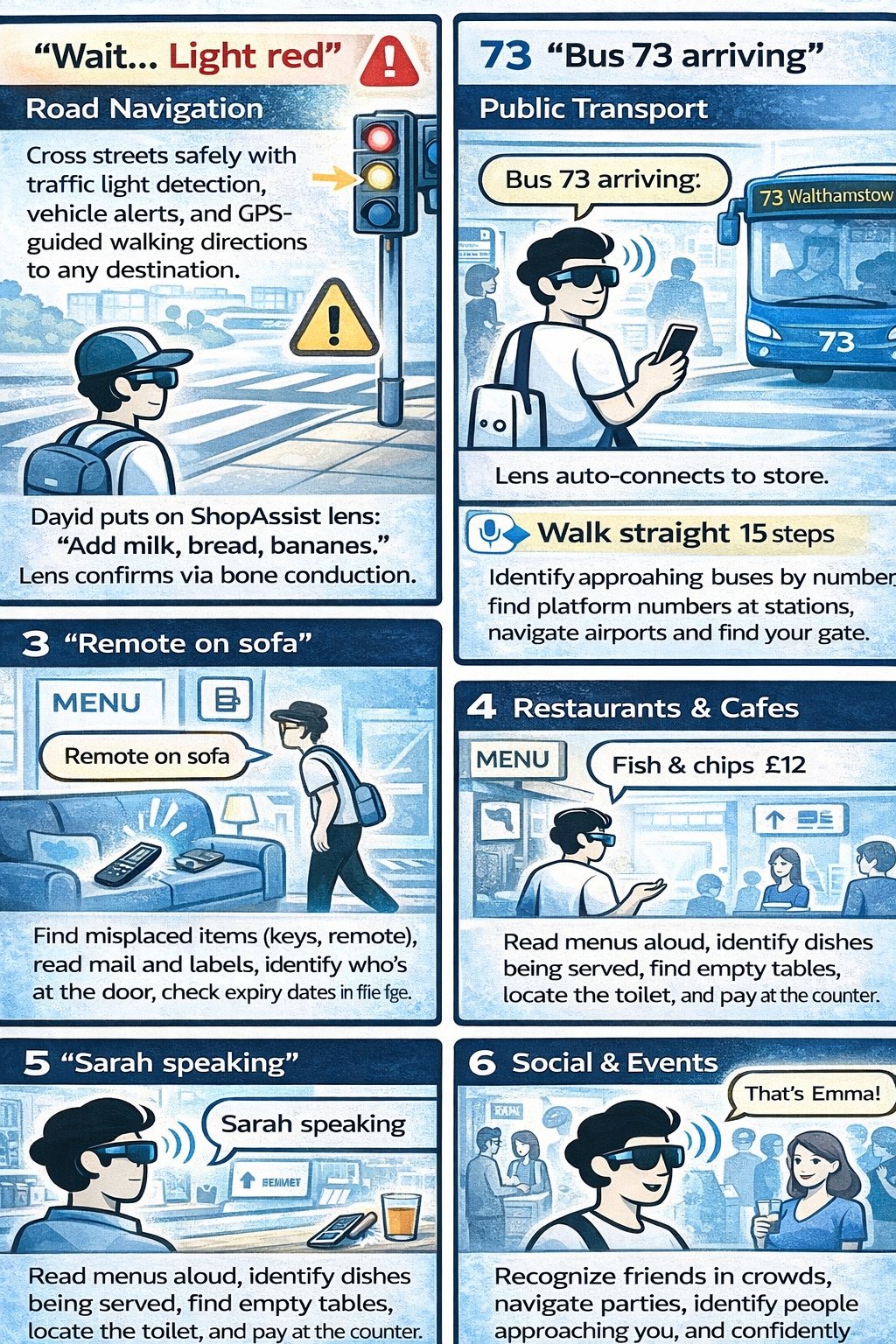
ShopAssist smart lens isn't just for supermarkets. The same technology that guides users through store aisles can transform every aspect of daily life—from crossing busy streets to finding the TV remote at home.
Reflection